As ad platforms automate targeting, bidding, and creative delivery, a strange paradox has emerged in pay-per-click advertising: marketers have less direct control over campaign mechanics, yet the stakes for input quality have never been higher.
In a world driven by Performance Max and Smart Bidding, manual account tweaks, like micro-adjusting keyword bids or tweaking device modifiers, yield diminishing returns. Today, your primary lever for growth isn’t how you manage the platform, but the quality and depth of the data you feed it.
Brands that treat their first-party data as a core strategic advantage are outperforming those relying solely on standard browser tags. Here is how to build a privacy-first data strategy that directly powers your Google Ads engine.
Why First-Party Data Is the Ultimate PPC Moat
Google and Boston Consulting Group research has found that mature first-party-data activation can produce meaningful revenue and efficiency gains. In BCG’s Responsible Marketing with First-Party Data research, companies that connect their first-party data sources can generate roughly twice the incremental revenue from a given ad placement and about 1.5 times the cost-efficiency improvement compared with brands that have limited integration.
The regional follow-up, Think with Google’s First-party data playbook for marketing, reports 1.5x more revenue from activating first-party data in even one use case, scaling up to 2.9x when brands activate it across all four use cases studied. Results vary by data maturity, activation use case, and measurement design; these are research findings, not a guaranteed outcome for any single account.
There are three key drivers behind this performance gap:
- Signal Loss Resilience. Safari’s Intelligent Tracking Prevention, browser restrictions, consent choices, ad blockers, and other measurement gaps reduce what’s directly observable through client-side pixels. Google Ads uses modeled conversions to fill some of that gap, but advertisers still gain from improving the quality and completeness of consented first-party measurement rather than depending on a browser tag alone.
- Competitive Differentiation. Keywords and platform audience interests are available to everyone, including your direct competitors. Your customer order histories, product profit margins, and sales lead scoring are uniquely yours.
- Algorithm Alignment. AI bidding models optimize for whatever success metric you define. If the primary conversion is a raw form fill, Smart Bidding may optimize toward lower-cost form submissions rather than the highest-quality opportunities. When you reliably import qualified-lead, closed-won, revenue, or margin-informed values, the bidding system has a stronger signal to optimize toward commercially meaningful outcomes. This is not just a reporting improvement. Smart Bidding uses conversion and conversion-value data directly in its optimization, so the outcome you designate as primary becomes a directional input to the system. A lead-gen account that optimizes to every form fill can train toward inexpensive, low-quality submissions; an account that reliably imports qualified opportunities or closed revenue can align its bidding logic more closely with commercial outcomes. Conversion adjustments matter here too: retractions and value restatements change reported conversion value and can shift CPA and ROAS bid strategies.
Beyond Basic Tracking: Collecting Zero- and First-Party Signals
Building an effective data stream requires expanding what you capture across the customer lifecycle. This involves combining both first-party data (observed behavior) and zero-party data (information customers intentionally share with you).
- Zero-Party Intent Signals: Interactive quizzes, onboarding preference centers, and form fields that capture budget range, timeline, or company size. Passing these signals to your CRM gives you an immediate lead quality score.
- Granular First-Party Outcomes: Rather than stopping at a lead submission or cart checkout, map downstream events such as “Qualified Demo Completed,” “Proposal Sent,” “Order Dispatched,” or “Subscription Renewed.”
- Profitability & COGS: For e-commerce, tracking gross revenue can lead Smart Bidding to prioritize high-revenue, low-margin products. Where a business can calculate a reliable conversion-level margin value, importing a net-revenue or profit-informed value can better align bidding with actual margin than gross-revenue-only measurement. Validate the calculation method, timing, and refund logic before making it the primary optimization signal.
Data Governance Tip: Hashing is an important safeguard, but it’s not a substitute for permission, disclosure, and data minimization. Google requires advertisers using enhanced conversions to accept applicable customer-data and data-processing terms; user-provided data isn’t processed until those terms are accepted and any required consent signals are granted. For Customer Match in the EEA, Google requires consent signaling for both ad_user_data and ad_personalization; without it, data can’t be used for ad personalization (see How to provide consent for Customer Match). A clear value exchange, such as an instant estimate or exclusive content, increases voluntary user opt-ins.
Architecting the Pipeline Back to Google Ads
Once collected in your CRM or database, first-party data must flow back into Google Ads without friction. Tools like Google Ads Data Manager make connecting disparate data silos simpler, but the strategic execution comes down to four pipeline architectures:
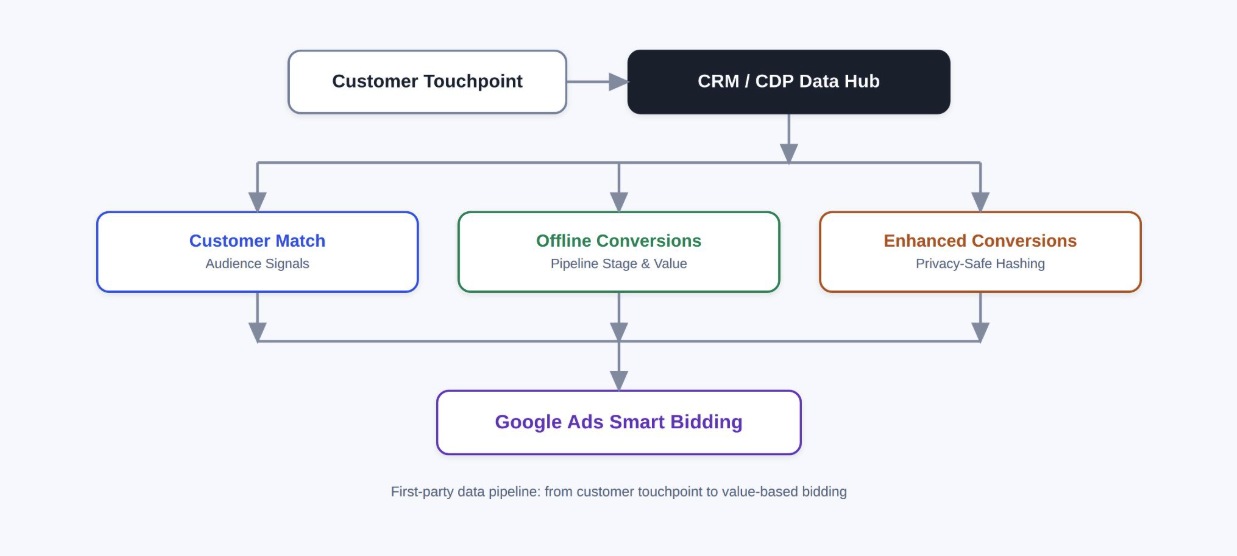
Implementation note: Google’s data-ingestion workflow is evolving. Starting June 15, 2026, offline conversion imports and enhanced conversions for leads uploads moved to the Data Manager API and became restricted in the Google Ads API for developer tokens that were not allowlisted based on prior usage. Build new automated workflows around Google Ads Data Manager and the Data Manager API rather than relying on legacy Google Ads API upload paths. See Google’s About offline conversion imports documentation for current migration guidance.
- Enhanced Conversions for Web and for Leads
Enhanced Conversions comes in two related but distinct forms (see About enhanced conversions):
- Enhanced conversions for web can improve measurement for on-site conversions by using consented, user-provided data, such as email address, phone number, or address, that is standardized, hashed with SHA-256, and sent to Google. Google can use the hashed data to match conversions to Google accounts that were signed in when users engaged with an ad.
- Enhanced conversions for leads extends that measurement downstream by combining hashed first-party lead data with imported offline milestones, such as qualified opportunities, booked appointments, or closed-won revenue. This gives advertisers more durable inputs for measurement and bidding in longer sales cycles.
- Automated Offline Conversion Tracking
To optimize for actual sales, set up direct integrations between your CRM (Salesforce, HubSpot, or custom databases via API) and Google Ads. When a lead moves to “Closed-Won” or an offline phone call results in a booked job, automatically push that milestone back to Google Ads along with its actual deal value.
- Continuous Customer Match Syncing
Customer Match should not be a static CSV upload done once a quarter. Establish automated connections that continuously sync audience lists, such as high-LTV repeat buyers, churning subscribers, or recent converters, to Google Ads (see About Customer Match and Customer Match Best Practices). Treat Customer Match as a governed lifecycle audience program, not a one-time spreadsheet upload: build separate, purpose-specific audiences for high-value customers, recent purchasers, and churn-risk subscribers, each governed by documented consent and retention rules. Google’s best-practices guidance also notes that enabling Enhanced Conversions can support automatically generated, real-time conversion-based customer lists.
Use these lists as:
- Audience signals in Performance Max to jumpstart machine learning, keeping in mind that how a list gets used depends on campaign type, account eligibility, geography, and consent. “Provide relevant audience signals where available” is a safer framing than treating a list as deterministic targeting.
- Exclusions in acquisition campaigns to avoid spending budget on existing customers.
- Targeting lists for cross-sell and re-engagement campaigns.
- Conversion Retractions and Adjustments
When an order is canceled, refunded, or determined to be spam, submit a conversion adjustment where appropriate. Per Google’s article, About conversion adjustments, a retraction permanently removes the conversion and sets its value to zero. This can improve reporting integrity and reduce misleading inputs to CPA- and ROAS-based bidding. A retracted conversion cannot subsequently be adjusted.
For example, if an account receives a wave of bot-generated form submissions that Google Ads initially records as conversions, leaving those submissions in place can distort the outcomes used for optimization. Retracting confirmed invalid conversions helps ensure reported performance and future bidding signals better reflect legitimate prospects.
Activating the Loop with Value-Based Bidding
Connecting your data pipeline is only half the battle; the final step is changing how your ad campaigns make decisions.
Once revenue, profit, or lead-stage values flow into Google Ads reliably, transition your campaigns from volume-based bidding strategies (Maximize Conversions or Target CPA) to value-based bidding (Maximize Conversion Value or Target ROAS). By bidding on value rather than volume, you delegate auction-level decisions to Google’s machine learning while maintaining complete control over what “value” means to your business. This aligns ad spend directly with real-world revenue and bottom-line profit.
Practitioner checklist: Before moving a campaign to value-based bidding, verify that conversion names and IDs match across the site, CRM, and Google Ads; values use a consistent currency and business definition; duplicate imports are prevented; refunds and spam are adjusted out; and consent status is stored with each activation event.
Methodology note: Performance outcomes from first-party-data activation vary based on consent rates, match rates, sales-cycle length, conversion lag, data hygiene, campaign volume, and the accuracy of reported value. The cited BCG/Google figures describe research findings, not guaranteed results for any individual account.
Sources
- Responsible Marketing with First-Party Data (BCG)
- First-party data playbook for marketing (Think with Google)
- About enhanced conversions (Google Ads Help)
- About enhanced conversions for leads (Google Ads Help)
- Set up enhanced conversions for web using the Google tag (Google Ads Help)
- About offline conversion imports (Google Ads Help)
- About Customer Match (Google Ads Help)
- Customer Match Best Practices (Google Ads Help)
- How to provide consent for Customer Match (Google Ads Help)
- About conversion adjustments (Google Ads Help)